

 by Graham Dyer
A growing number of apartment searches don’t start on Google anymore. They start in a conversation. “Find me a one-bedroom under $2,000 near the park in Montclair with in-unit laundry.” Not typed into a search bar — asked to ChatGPT, Claude, Gemini or Perplexity. The answer comes back as a curated shortlist, not ten blue links. And if your property isn’t on that shortlist, you never existed.
This is Generative Engine Optimization — GEO — and it’s the SEO problem that most property managers haven’t heard of yet. The good news: if you’re already running Engrain SightMap and a PMS feed, you have the best possible foundation. The interactive map, the unit data and the floor plan metadata — it’s all there. The next step is making that data readable by the AI models that renters are increasingly turning to.
How AI search actually works
When someone asks ChatGPT for apartment recommendations, it doesn’t search Google on your behalf. It pulls from its own training data, from web pages it can crawl in real time and increasingly from structured data files that websites publish specifically for AI consumption.
That last part is the key. Google has used structured data (JSON-LD, Schema.org) for years to power rich results — those cards with star ratings, pricing and availability that appear above the regular listings. AI models use the same data, plus a newer format called llms.txt — a plain-text file that tells AI crawlers exactly what your site offers, in a format they can parse without guessing.
If your property site publishes structured data and llms.txt alongside your existing SightMap integration, AI models can recommend your property with accurate pricing, availability and amenity data. Without it, they’re left guessing from marketing copy — or recommending a competitor whose data they can read.
What renters are actually asking
The queries that AI search handles well are exactly the ones property managers care about most:
- “Two-bedroom apartments under $2,500 on the Lower East Side available in August”
- “Pet-friendly apartments near PATH with a gym and parking”
- “Compare one-bedrooms at [Your Property] vs [Competitor]”
- “Which apartments in [neighbourhood] have in-unit laundry and virtual tours?”
These are high-intent, ready-to-lease queries. The renter knows what they want. They’re not browsing — they’re shortlisting. If the AI can pull your unit data (prices, beds, baths, amenities, availability dates and tour options) from structured sources, your property makes the cut. If it can’t, it recommends whoever’s data it can find.
The opportunity for SightMap properties
If you’re running Engrain SightMap, you already have the richest dataset in multi-family: an interactive, unit-level map tied to live PMS data. Floor plans, pricing, availability, amenities and move-in dates — it’s all flowing through Engrain’s platform every day. That’s a massive head start.
The opportunity is taking that same data and extending it into formats that AI crawlers and search engines can consume directly:
- Real HTML with real data. Unit names, floor plan types, bed/bath counts, square footage, pricing, availability dates and amenities — rendered as actual HTML elements on your page alongside your SightMap. This gives crawlers (both traditional and AI) a complete picture of your inventory.
- JSON-LD structured data. Schema.org markup that tells both search engines and AI models exactly what your property offers. An
ApartmentComplexwith nestedAccommodationentities, each withOfferpricing,FloorPlanreferences andamenityFeaturelists. This is what powers Google’s rich results today and what AI models use for structured recommendations. - llms.txt. A plain-text file at
yoursite.com/llms.txtthat gives AI crawlers a structured overview of your property: what it is, where it is, what’s available and how to get more detail. Think of it as robots.txt for AI — except instead of telling crawlers what to ignore, it tells them what to pay attention to.
A simplified example of what structured data looks like in your page’s source:
ApartmentComplex: “The Meridian”
→ Accommodation: “Unit 4B” — 2 bed, 2 bath, 1,100 sqft
→ Offer: $2,450/month, available June 1
→ Amenities: in-unit laundry, balcony and parking included
→ FloorPlan: “The Hudson”
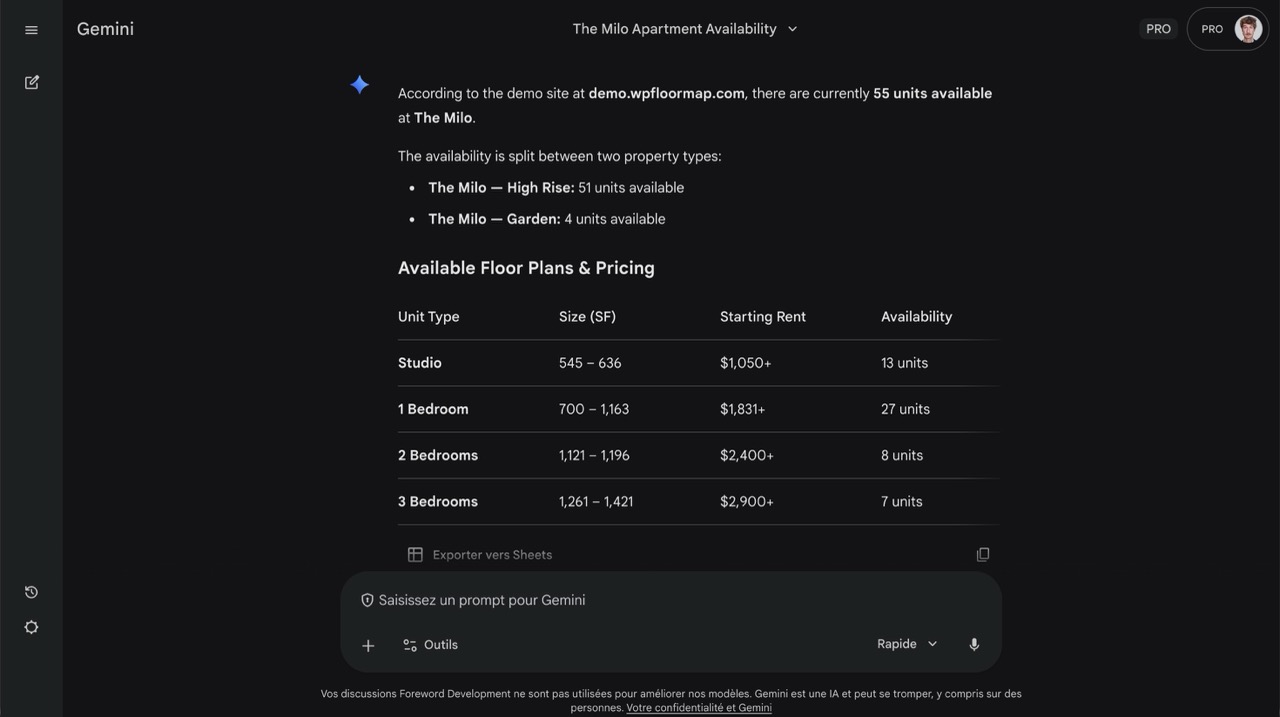
When an AI model encounters this, it doesn’t have to guess. It can directly answer “What two-bedrooms are available at The Meridian?” with accurate, current data — data that comes straight from the same PMS feed already powering your SightMap.
How WP FloorMap makes your SightMap AI-ready
WP FloorMap is a WordPress plugin that works alongside your existing Engrain SightMap integration. It takes the PMS data already flowing through Engrain and renders it natively on your WordPress site — as real HTML elements that crawlers can read, complete with automatically generated JSON-LD and llms.txt.
Your SightMap stays exactly where it is, doing what it does best: giving prospects an interactive, visual way to explore your property. WP FloorMap adds a complementary layer that makes the same data visible to search engines, AI models and analytics tools.
- Automatic structured data. Every time a unit leases, a price changes or a new floor plan goes live, your JSON-LD updates with it. No manual tagging, no separate CMS entries and no SEO consultant needed.
- Auto-generated llms.txt. A machine-readable summary of your property, updated live from your PMS feed. AI crawlers get a clean, structured overview of everything you offer.
- Full analytics coverage. Unit cards and floor plan listings are part of your page, so GA4 events fire natively. You can finally answer “which floor plan gets the most attention?” and “where do prospects drop off before booking?”
- No code required. WP FloorMap ships as Gutenberg blocks that your marketing team can drag and drop in the WordPress editor. The interactive map, the unit listing, the floor plan filter and the tour scheduler — each one is a block you arrange like any other element on your page.
Your Engrain subscription powers the interactive map. Your PMS powers the data. WP FloorMap makes sure that data is visible everywhere it needs to be — on the page for prospects, in Google for search and in AI models for the next generation of apartment discovery.
The window is now
AI-powered apartment search is growing fast, but adoption is still early. Most properties haven’t thought about GEO yet. Their sites don’t publish structured data, don’t have llms.txt and rely entirely on Google Ads and ILS listings to drive traffic.
That gap won’t last. The properties that publish structured data and llms.txt now will build authority in AI recommendation systems while the field is uncrowded. By the time everyone catches up, you’ll already be the property that ChatGPT recommends.
If you’re already running SightMap, you have the data. The question is whether AI can see it.
See how WP FloorMap handles GEO · Try the live demo · Get in touch
Ready to see the difference?
Schedule a call and we’ll walk you through WP FloorMap on your own property data.